Kawaneen
An Arabic legal AI platform designed around hybrid retrieval, reranking, citation-grounded answering, and safe abstention.
Explore the case study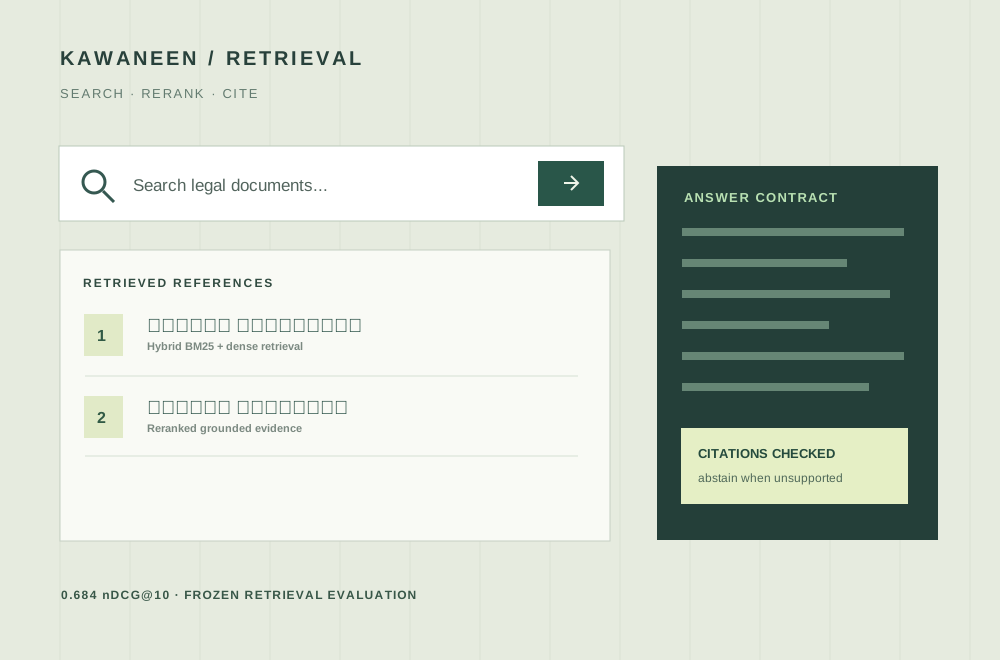
Original explanatory illustration, not a screenshot of the application.
Legal answers need their evidence attached.
Arabic legal document collections are difficult to navigate with basic keyword search alone. A useful legal assistant needs to retrieve the right source text, answer only when supported, and make its citations inspectable.
Kawaneen is an Arabic legal AI and retrieval-augmented generation platform with Search, Ask, and Extract workflows. It combines retrieval, reranking, structured extraction, citation-grounded question answering, and safe abstention.
Retrieval quality is part of answer quality.
The application uses Python, FastAPI, Streamlit, Qdrant, Docker Compose, and MLflow. Hybrid lexical/semantic search helps cover the different ways legal concepts may be expressed, while reranking improves the order of supporting passages.
The citation contract is treated as an engineering requirement, not just a nice formatting detail. Unsupported output should be rejected or abstained from rather than presented with invented references.
Evaluate the retriever and the answer contract separately.
On a frozen retrieval evaluation dataset, structure-aware chunking improved nDCG@10 from 0.639 to 0.684. In a controlled development evaluation, citation-contract defects fell from 29 of 40 to 0 of 40.
Why these choices?
- Hybrid retrieval: combine exact lexical matching with semantic retrieval instead of relying on either alone.
- Structure-aware chunking: keep source divisions meaningful, then measure whether ranking actually improves.
- Grounded answering: make citation correctness and abstention part of the response contract.
The result is an application that demonstrates retrieval evaluation and trust boundaries—two important concerns in applied LLM systems.
Explore the work.
A direct public repository URL and application demo can be added once confirmed.